
The AI–IR series · Part Two of four
AI to IR: The Road, Built on Logic
Last time I argued that the thing our field never built was a road from a detection to an accountable decision, running at the speed the machine now moves. Standards describe the destination. None of them is the road. A July incident showed what its absence costs.
I closed by asking you to imagine a clear architecture in place of the broken one, and seven new measurements to go with it. This follow-up is that picture. The architecture exists, and it produces those measurements. What I can show here is the outside of it and the numbers it produces, not the inside.
A note on that boundary, so it is clear from the start. This is architectural intellectual property and it is patent pending, so I am showing the shape and the results and holding back the mechanism. That is the reason some of what follows is described by what it does rather than how it does it.
What it looks like from the outside.
It is one sealed unit. A detection goes in one end, and an accountable, verified decision comes out the other.
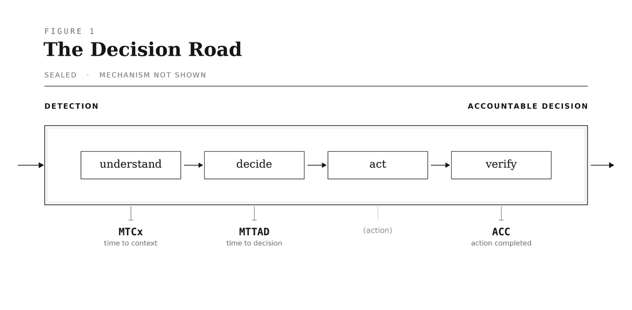
Inside, it moves through the phases every responder already knows: understand, decide, act, verify. What is different is not the phases. It is that the road between them is built, it runs without a person assembling the information by hand, and every step is measured.
The box stays closed on purpose. What matters is that a detection crosses all of them, carrying the information that makes it mean something, and reaches a person fast enough for their judgment to still count, with a fixed rule standing between any conclusion and any action.
And zero AI in the decision path. Not because it isn't valuable, it just isn't ready yet.
The Measurements
A measurement describes what you are counting, not how you achieved it, so this is the part I can show in full. These are seven things the industry has not had a number for, because until the road was built there was nothing to measure across. They fall into three groups.
Speed, how fast the road runs:
Time to Context (MTCx). From detection to the moment the full situation is assembled and ready for a decision. This is the interval that used to be manual, minutes on a good night and hours on a normal one. It is now a number you can watch and reduce.
Time to Decision (MTTAD). From detection to an accountable, authorized decision actually existing. Not a guess produced, a decision owned.
Time to Verified Action (MTTVA). From the decision to the action carried out and confirmed, rather than fired and assumed.
Fidelity, how sound and how consistent the decision was:
Decision Fidelity (IFQ). How complete and correct the assembled picture was that the decision rested on. It answers something that was never measurable before: how good was the ground the person was standing on when they decided.
Fidelity Floor (IFQ-FL). The worst case rather than the average. Averages flatter you; this is the number that tells you how bad the ground can get on the worst day.
Convergence (C). How strongly the independent signals agreed on the same conclusion, rather than a single confident voice taken on faith.
Assurance, whether you can show it happened:
Action Completion (ACC). Whether the authorized action actually completed and was verified as done. The difference between believing you responded and knowing you did.
Seven numbers, and the same circumstance produces the same answer every time. That consistency is the point. Not probabilistic. Not AI. A decision produced at machine speed, grounded in Logic and based on fact. The facts that matter to you at any given time of the day.
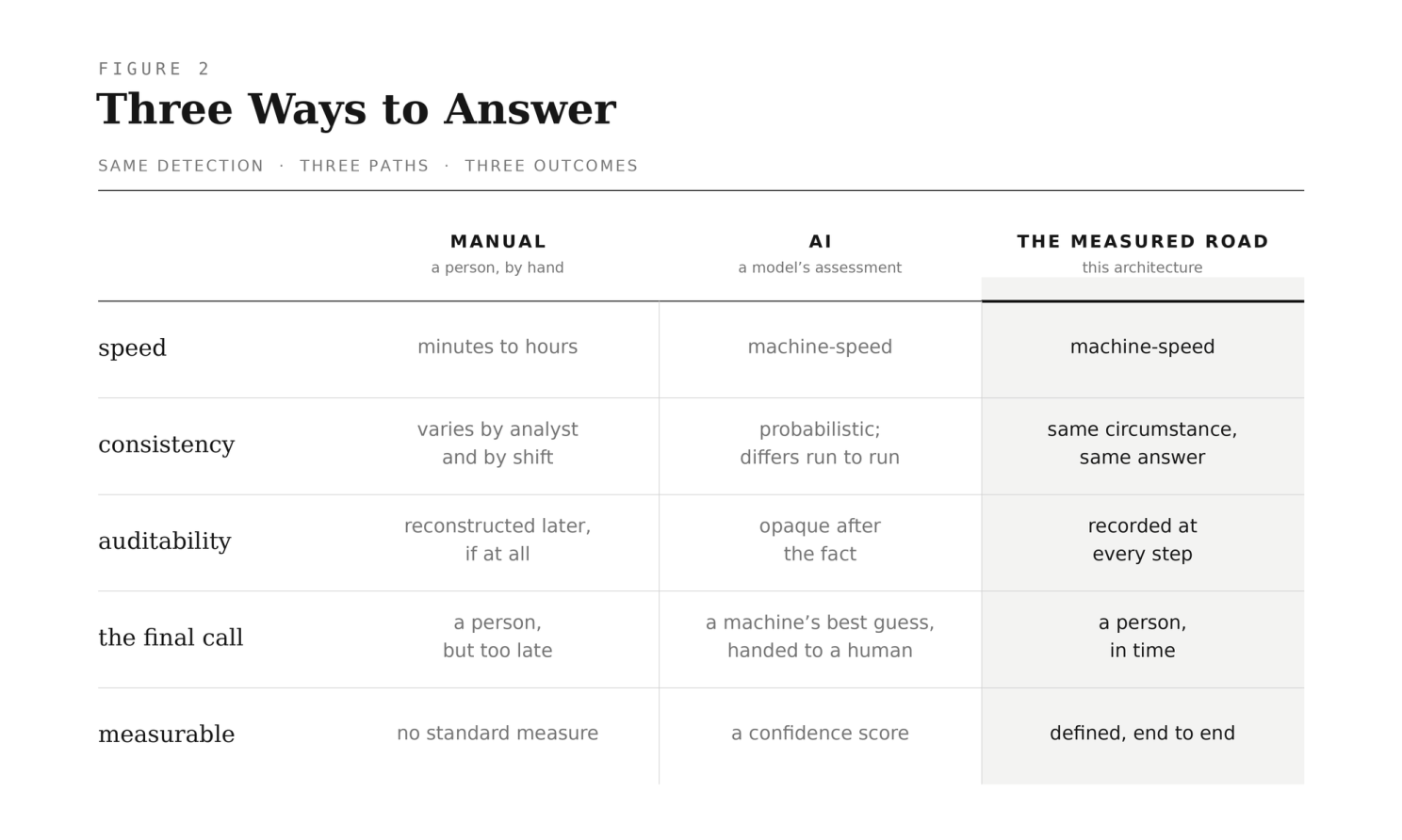
Why this is different from what you have now
None of the left column is a failing of the people. As I said in the first piece, the people were always able to decide. What they never had was the road, the speed, and the numbers.
What this is, and what it is not
It is not a smarter model, and it does not make AI safe, because nothing makes AI safe. It does not patch the flaw an attacker climbs through. It is the missing structure, the one every standard assumes and none provides, that carries a detection to an accountable human decision at machine speed, holds a fixed and auditable line at the point of consequence, and measures every step of the way. I built it because the road was missing, and the cost of leaving it unbuilt is no longer hypothetical, it is measured in breaches like July's.
The road is now built. Now we measure it.